Showing posts with label medicine. Show all posts

Wednesday, July 28, 2021

Big Ideas, Simply Explained

An exciting new series from DK Publishing has arrived at the library. We have the following titles in the Big Ideas Simply Explained series. 

"Enter the world of myths and legends with this unforgettable compendium that spans the centuries and crosses the continents to share the greatest stories of all time. Sit back and enjoy more than 80 classic myths retold for the modern reader with engaging text and eye-catching graphics. Part of the Big Ideas series, The Mythology Book introduces the great and the good, from the gods of ancient Greece to the stories of the Cherokee People of North America. Going beyond the ancient worlds, this book brings to life influential tales of Aboriginal Australians and the Aztecs, each packed with compelling characters, plot twists and turns, and incredible insight into human existence. Discover the lessons behind every story and get to the heart of cultures far and wide through the inspiring narratives that capture the way communities work together to make sense of the world around them. This is essential reading for everyone who delights in stories of imagination, action, and adventure, taking new generations back in time to love and learn from the stories of the past." (from Amazon.com)

"This comprehensive, accessible, and authenticated guide to Islam is essential to understanding the world's fastest-growing religion. This essential guide to Islam covers every aspect of the Muslim faith and its history - from the life of the Prophet Muhammad and the teachings of the Koran to Islam in the 21st century. Celebrating the scientific, literary, and artistic achievements of the Islamic Golden Age and the ideas of philosophers and theologians across the centuries, it opens a window on the Islamic world. Clear factual writing offers insight into terms like Sharia law, the Caliphate, and jihad; Sunni and Shia divisions; and Sufi poetry and music. Images of Islamic art, architecture, calligraphy, and historical artifacts illustrate the articles while the Big Ideas' trademark infographics and flowcharts explore and explain the central tenets of Islam, such as prayer, fasting, and pilgrimage. Modern issues such as fundamentalism are discussed in context alongside the work of peaceful traditionalists, modernizers, and women's rights campaigners, among others. Packed with inspiring quotations and bold illustrations, The Islam Book is an invaluable source of information both for members of one of the world's major religions and readers looking for a clear unbiased guide to the meaning of this faith." (from Amazon.com)

"You don’t have to be a scientist to find this beginner’s biology book fascinating! What is life? Why do bees dance? How do animals know their mothers?  Who discovered germs? Discover the living world, how it interacts with the environment, and stand in awe of the most interesting biology facts, theories, and discoveries. The Biology Book is written in simple English making complex biological ideas accessible to everyone! Whether you’re a student or lay-scientist, you’ll find these pages exciting and educational because it: 

   • Combines creative typography, graphics, and accessible text to explore the most famous and important ideas in biology and the people behind them

   • Includes a directory section for easy localization

   • Profiles more than 95 ideas and events key to the development of biology and the life sciences, with thought-provoking graphics throughout that demystify the central concepts behind each idea

   • Features insightful and inspiring quotes from leading biologists and scientists, such as 2020 Nobel Laureates, Emmanuelle Charpentier and Jennifer Doudna, as well as thinkers in other fields

Learn everything you wanted to know about Biology. Over the last few centuries, humans have been enamored by the world around us. Trace the history of scientific thought and meet the scientists who shaped the natural sciences, such as Carl Linnaeus, Jean-Baptiste Lamarck, Charles Darwin, and Gregor Mendel. From the mechanics of plants, animals, and the human body; to DNA and genetic inheritance; and the development of vaccines, explore the crucial discoveries to understand how our world works. The Biology Book uncovers over 95 key ideas in the field of biology. Step by step flowcharts, diagrams, and accessible text will help demystify complex biological processes and help you enhance your understanding. This biology book also discusses current trends such as cloning, neuroscience, human evolution, and gene editing. Whether you’re new to the subject, a budding scientist, or keen to keep up with and understand current ethical and scientific debates, The Biology Book is for you." (from Amazon.com)

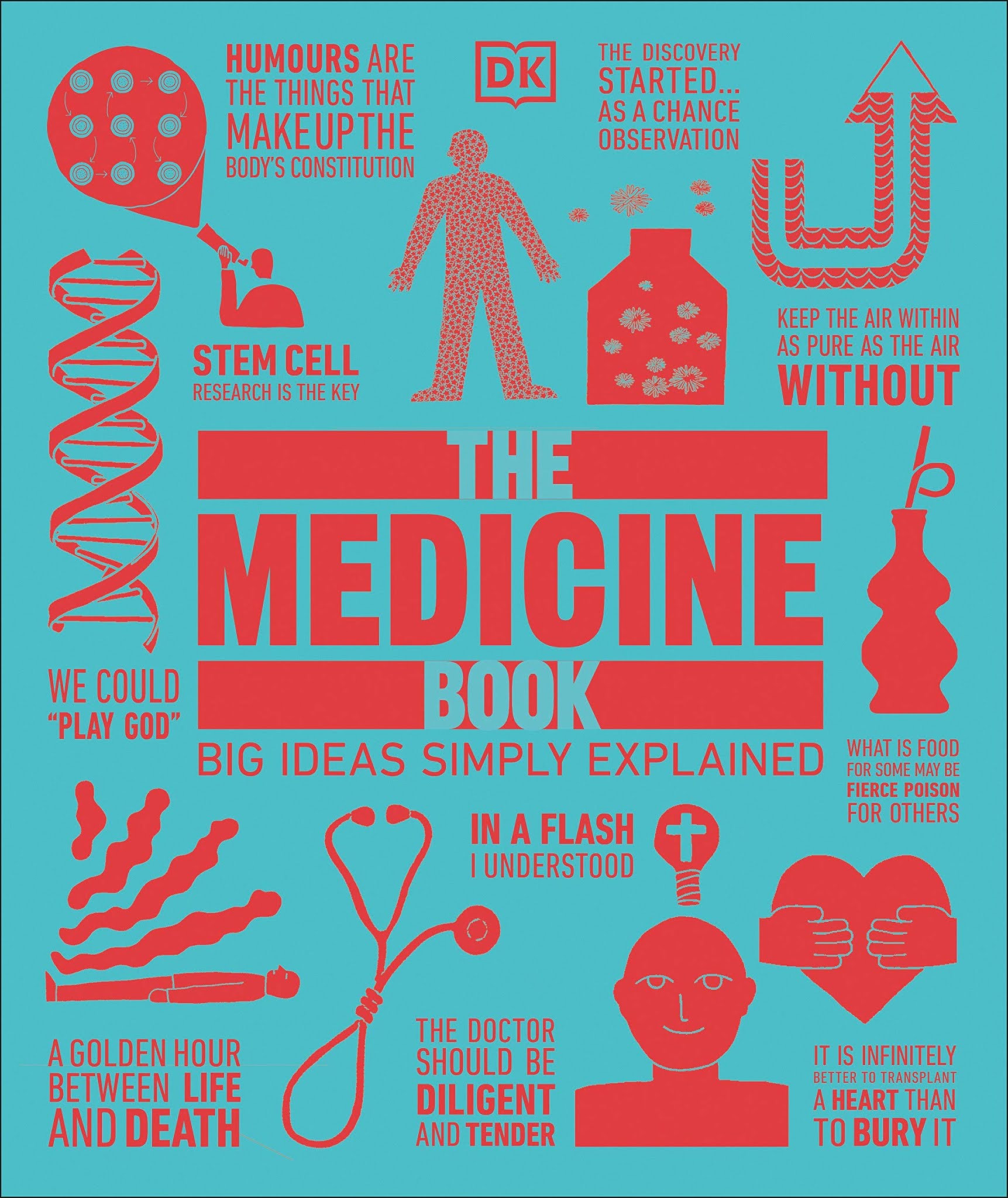
"Discover the most important and groundbreaking milestones in the history of medicine, and the people behind them. From ancient herbal remedies to modern drugs, this accessible medical reference book explores the breakthroughs and discoveries that have shaped our modern-day understanding of medicine. Inside the pages of this illustrated medicine history book, you’ll discover:

   • Profiles of more than 90 of the biggest ideas, breakthroughs, and milestones in international medical history

   • Thought-provoking graphics and flow-charts that demystify the central concepts behind each medical idea

   • Insightful and inspiring quotes from famous physicians, scientists, politicians, and academics

Learn about changes in medicine throughout the ages. How are illnesses diagnosed? How do vaccinations work? Why are some pandemics so deadly? This informative book about medicine through time answers big questions like these and many more! Packed with pithy explanations, step-by-step diagrams, and bright illustrations, The Medicine Book cuts through the jargon and offers a clear overview of the greatest medical breakthroughs. Learn about major diseases such as cancer and the global eradication of smallpox. Explore new developments in IVF and gene manipulation, as well as medical science's response to global challenges, such as the COVID-19. It’s perfect for medical professionals, students of medicine, or anyone interested in the fascinating medical history of the world." (from Amazon.com)

"What is Fauvism? Which event inspired Picasso’s Guernica? Who connects Andy Warhol and David Hockney? This comprehensive volume answers all these and more. In a grand timeline of art, it explains how one movement influenced the next, discusses influential painters, sculptors, and artists, and showcases 80 of the world’s greatest artworks. Throughout history, art has taken many forms and offers a kaleidoscopic variety of expression. With The Art Book as your companion, you can browse the world’s most important artworks, from prehistoric Altamira cave paintings to pop art and avant-garde video installations. You can observe artistic inspiration evolving from religious themes in the Middle Ages to abstract shapes and color in the 20th century and understand the ideas that inspired masterpieces by Botticelli, Rembrandt, Klimt, Matisse, and many more. Annotations draw attention to key details of masterpieces, and diagrams offer succinct explanations of art forms and help you contrast techniques of painters such as Cézanne and van Gogh. With insightful quotations and detailed timelines, The Art Book is a thought-provoking and essential reference for students and art-lovers everywhere." (from Amazon.com)



Wednesday, January 2, 2019

Science and Medicine Non-Fiction

"Pulse of Perseverance--by Joseph Semian, Jr. MD; Pierre Johnson MD; and Maxime Madhere MD--is the honest, deeply personal tale of three young black men's refusal to succumb to failure and how, together, they overcame daunting odds to take their place among the just five percent of U.S. doctors who are black. Through writing as passionate as it is relatable, the authors provide an unflinching look at the barriers black Americans face as they try to move out of the place society has designated for them. This book is a searing indictment of our still separate and unequal education system, one that ensures the road to becoming a doctor, or a lawyer or professor, will be much harder for black children than it will be for white. Yet, at its core, Pulse of Perseverance is an inspirational story of what can be accomplished with dedication, the support of people with similar goals, and the investment from institutions dedicated to black success. This book is the North Star for every black child who sees something greater for himself than the world would have him believe."(Publisher's description)

The story of poison is the story of power--at least according to Eleanor Herman in The Royal Art of Poison: Filthy Palaces, Fatal Cosmetics, Deadly Medicine, and Murder Most Foul. "For centuries, royal families have feared the gut-roiling, vomit-inducing agony of a little something added to their food or wine by an enemy. To avoid poison, they depended on tasters, unicorn horns and antidotes tested on condemned prisoners. Servants licked the royal family's spoons, tried on their underpants and tested their chamber pots. Ironically, royals terrified of poison were unknowingly poisoning themselves daily with their cosmetics, medications and filthy living conditions. Women wore makeup made with lead. Men rubbed feces on their bald spots. Physicians prescribed mercury enemas, arsenic skin cream, drinks of lead filings and potions of human fat and skull, fresh from the executioner. Gazing at gorgeous portraits of centuries past, we don't see what lies beneath the royal robes and the stench of unwashed bodies; the lice feasting on private parts; and worms nesting in the intestines. The Royal Art of Poison is a hugely entertaining work of popular history that traces the use of poison as a political - and cosmetic - tool in the royal courts of Western Europe from the Middle Ages to the Kremlin today." (Alibris.com)

"A smart and compelling examination of the science of immunity, the public policy implications of vaccine denial, and the real-world outcomes of failing to vaccinate. If you have a child in school, you may have heard stories of long-dormant diseases suddenly reappearing―cases of measles, mumps, rubella, and whooping cough cropping up everywhere from elementary schools to Ivy League universities because a select group of parents refuse to vaccinate their children. Between Hope and Fear by Michael Kinch tells the remarkable story of vaccine-preventable infectious diseases and their social and political implications. While detailing the history of vaccine invention, Kinch reveals the ominous reality that our victories against vaccine-preventable diseases are not permanent―and could easily be undone.This book relates the remarkable intersection of science, technology and disease that has helped eradicate many of the deadliest plagues known to man." (Amazon.com)

"Science doesn’t speak for itself. Neck-deep in work that can be messy and confounding and naïve in the ways of public communication, scientists are often unable to package their insights into the neat narratives that the public requires. Enter celebrities, advocates, lobbyists, and the funders behind them, who take advantage of scientists’ reluctance to provide easy answers, flooding the media with misleading or incorrect claims about health risks. Amid this onslaught of spurious information, Americans are more confused than ever about what’s good for them and what isn’t. In Bad Advice (Or Why Celebrities, Politicians, and Activists Aren't Your Best Source of Health Information), Paul A. Offit shares hard-earned wisdom on the dos and don’ts of battling misinformation. For the past twenty years, Offit has been on the front lines in the fight for sound science and public heath. Stepping into the media spotlight as few scientists have done―such as being one of the first to speak out against conspiracy theories linking vaccines to autism―he found himself in the crosshairs of powerful groups intent on promoting pseudoscience. Bad Advice discusses science and its adversaries: not just the manias stoked by slick charlatans and their miracle cures but also corrosive, dangerous ideologies such as Holocaust and climate-change denial. Written with wit and passion, Offit’s often humorous guide to taking on quack experts and self-appointed activists is a must-read for any American disturbed by the uptick in politicized attacks on science." (Publisher's description)

Wednesday, April 11, 2018

Science and Medical Non-Fiction

What happens when institutional racism and junk forensic science come together? Radley Balko and Tucker Carrington explore this scenario in their book, The Cadaver King and the Country Dentist: a True Story of Injustice in the American South. After two three-year-old girls were raped and murdered in rural Mississippi, law enforcement agents arrested and convicted two innocent men--Kennedy Brewer and Levon Brooks. By the time they were exonerated in 2008, they had spent a combined thirty years in prison based largely on the testimony of two men--Dr. Steven Hayne and Dr. Michael West. For nearly twenty years, Hayne, a medical examiner, performed the vast majority of Mississippi's autopsies, while his friend, West, a local dentist, touted his skill as a forensic jack-of-all-trades. They became the go-to experts for prosecutors all over the state and helped to convict many Mississippians, however, some of those convictions began to fall apart.

Lindsy Fitzharris writes about surgical innovations in The Butchering Art: Joseph Lister's Quest to Transform the Grisly World of Victorian Medicine. Nineteenth-century surgery was brutal. Surgeons, working before anesthesia, were lauded for their speed and brute strength. Surgical theaters were no place for the squeamish, either. The most baffling outcome of these surgeries was the extremely high mortality rates of post-operative infections. Into the fray steps and unassuming Quaker surgeon by the name of Joseph Lister, who worked tirelessly to solve the mystery of these infection deaths and whose efforts would revolutionize science and medicine forever.

The History of Medicine in 50 Discoveries is by Marguerite Vigliani, MD and Gale Eaton. This book, arranged in chronological order, lists 50 medical discoveries that helped mankind leap forward in our evolution. For instance, a 5,000 year old mummy was found to have 61 tattoos--most of which matched acupuncture points--and walnut-sized pieces of medicinal fungus. Neolithic surgeons bored holes in patients' brains to relieve pressure at least 10,000 years ago. From Mesopotamian pharmaceuticals and ancient Greek sleep therapy to germs, X-rays, and modern prosthetics and organ transplants, this book traces all of the inspirations, accidents, and dogged determination that has helped humanity's ability to heal itself.

Wednesday, September 27, 2017

Medical Related Non-Fiction


An American Sickness: How Healthcare Became Big Business and How You Can Take it Back is a book on the American healthcare system by Elisabeth Rosenthal. The author explains how our system of healthcare went from a caring endeavor to a convoluted and highly profitable industry in a few short decades. Rosenthal breaks down this behemoth system into its various components--hospitals, doctors, and insurance and pharmaceutical companies. She discusses how hospital systems that are managed by business executives act like predatory lenders and hound patients and seize their homes. Patients receive coded bills from doctors they never saw. Research charities get into bed with pharmaceutical companies and surreptitiously profit from the donations made by hard working people in good faith. Rosenthal offers hope by spelling out exactly how we can decode medical double speak, avoid the perils of the pharmaceutical scheme, and get the care you and your loved ones deserve.

Inferno: A Doctor's Ebola Story is by Steven Hatch, M.D. As an infectious disease specialist, Dr. Hatch came to Liberia in November 2013 to work at a hospital in Monrovia. Six months later, several of the physicians he had served with were dead or unable to work and Ebola had become an international worry. Hatch returned with the aid organization International Medical Corps to help establish and Ebola Treatment Unit. In this hastily built structure in the middle of the jungle, he witnessed the selfless care given by the unit's physicians, nurses, and other caregivers. He explores this deadly virus as well as the afflicted country of Liberia to reveal how the Ebola outbreak stoked anxieties that were exploited for political gain around the world. He discusses how generations of inequality left Liberia vulnerable to this crisis and how similar circumstances could fuel another plague elsewhere. Hatch feels that by understanding and alleviating these stressors, another outbreak in other countries could be curtailed more quickly.

A Surgeon in the Village: An American Doctor Teaches Brain Surgery in Africa is by Tony Bartelme. Dr. Dilan Ellegala goes to Tanzania and is shocked to find that there are only three brain surgeons for its population of forty-two million people. In Haydom Lutheran Hospital, even the most basic surgical tools are absent, not even a saw to open a patient's skull can be found. Here, people with head injuries or brain tumors are left to heal on their own or die. Dr. Ellegala is confronted with a villager suffering from severe head trauma, so he takes it upon himself to buy a tree saw from a farmer, sterilize it, and then uses it to save the man's life. Ellegala realizes that there are far too many neurosurgery patients for a single person to save and he will soon be leaving Tanzania. The only solution is to teach someone the skills necessary to perform these complicated and dangerous procedures. He finds his first potential student in Emmanuel Mayegga. Though he has no formal medical degree, Mayegga is a stubborn and determined medical officer who possesses the dexterity and intelligence to do brain surgery. As he guides the Tanzanians in their studies, he also challenges the Western medical establishment to do more than send vacationing doctors on short-term medical missions. He offers a solution that could potentially transform the care of more than two billion people around the world.